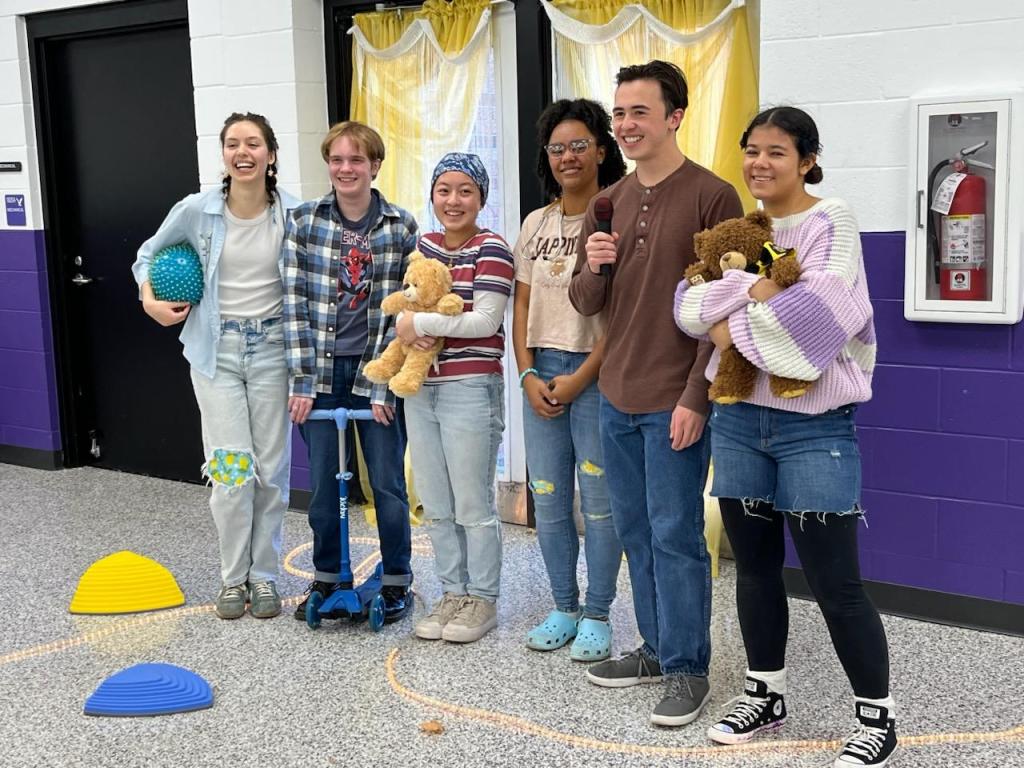
by Elsie Lemahieu
As you’ve probably heard, Memorial is putting on two school plays this year: Fidget and The Amazing Lemonade Girl. I went to the showtime on Friday — 7pm in the commons. Coming to the play a bit early is recommended; not only so you can find good seats, but also because there were tables set up for people to make fidgets, and there was a lemonade stand where you could get lemonade and donate money to cancer research.
First off, Fidget. In my opinion, Fidget was a great play. I have ADHD so I could really connect to the experiences the play revolved around in a more personal way.
The acting was beautiful, and the lighting and sound effects really added to the overall vibe. It was surprisingly nice to have it in the commons, since the audience didn’t feel as smushed together.
The space also provided more room for additional seating — including wobbly stools and gaming chairs, which were supposed to help people who maybe couldn’t sit still for longer periods of time.
The play accurately encapsulated how school and life in general feels like when you have ADHD, anxiety, depression, gender dysphoria, or other mental health struggles. It showed how hard life can be living with these.
The acting was cool, and the cast did a great job. One of the cast members, Maxx Christopherson, said: “I think we as a cast did an amazing job. I think we all did really well with what we were given and should be very proud of ourselves for getting through it.”
I definitely agree with Maxx, the cast needs to give themselves their own round of applause. I liked the scenes where the whole cast was involved, because it was cool when everyone was coordinated.
The play followed school life, with teachers constantly telling students to sit still, stand up straight, and pay attention. It followed the voices in our heads saying we’re not good enough. It followed gender stereotypes and how hard it is to be non-binary or trans in a mostly cisgender world.
It followed a lot of real-world issues that people deal with, often by themselves, every single day. And sometimes what we have is what defines us. Sometimes having ADHD is all people see, sometimes being non-binary or trans is all people talk about, and sometimes people just don’t understand.
I think we struggle with not knowing what our purpose is here, on this planet. We have to learn to accept people for who they are, not what they have. If what they have is what you see, you’ll never see past it. See people for who they are, accept them, respect them, and love them. Never make someone change for you. Change is something we do for ourselves.
“Fidget” not only displayed the struggles, but made people feel connected. It revealed the power of being different, and that being different is not something to be ashamed of. Our brains tell us all of these negative thoughts: “I’m fat,” “I have too much acne,” “I’m weird,” and many others, without realizing that nobody else is thinking this.
Sometimes we have to fight against our own brains. In conclusion, we’re all just humans dealing with our own struggles, even if it’s not obvious, and sometimes reaching out and just saying something as simple as “How are you, really?” can be monumental in taking the first steps to making new friends and forming new relationships. A great play, as always.
The next play, “The Amazing Lemonade Girl,” followed the true story of a young girl named Alexandria (Alex) Flynn-Scott, who was diagnosed with neuroblastoma when she was born. It was a hopeful yet heartbreaking play, one that they warned would be a “tear-jerker,” and it was. I heard many people begin to cry even only a few minutes into the play.
The play began with a couple people laughing to the right of the stage, out one of the exit doors.The door was open, and they walked through it, past a trail of sparkling lights and blocks, to the stage. I was a bit confused at first, because they went up and began talking to Alex, who was sick, about how she couldn’t go play with them yet.
Things took a turn when I realized that the bright path and door symbolized Heaven or the afterlife.
The format is Alex having to tell her story before she went to play with them, which led to Alex picking which people should act as who, and they went through the scenes: sometimes sad, sometimes happy.
The acting made me realize that this was real, and not just any play. It was extremely sad when her friend passed away from cancer, and when the brother talked about how hard it was for him to live with his sister. People still struggle with this now.
The family made a lot of sacrifices: they even had to move just so they could be as close as possible to a hospital that had the right treatment for her. The saddest part for me was not only the fact that she died when she was 8, but also the fact that this is still going on, and there is still not a cure for cancer.
Childhood cancer is devastating, because life is something we only experience once, and it’s so unfair that these kids never get to see more past their childhood. I think it was so inspiring to see her persevering through this really hard time, and remarkable how she kept doing a lemonade stand every year, and made her 1 million dollar goal just before she died. Even though she’s gone, she’s left a lasting imprint on people, not only inspiring other people who have cancer, but also those who don’t.
Her legacy is still living on today, well past her 1 million dollar goal. In fact, the foundation has now raised over 300 million dollars, all donated to cancer research. It’s insane to me how a kid that young, also struggling with cancer, still persevered not for herself, but in hopes of aiding scientists in finding a cure for cancer and other treatment plans. It’s inspiring, because though you’ve probably heard that you can make a difference, this is a real life specific example of a kid who managed to do just that.
I thought that the acting was incredible and the cast did a great job making the story come to life. One of the cast members, Isabella, who played the lead role as Alex, reminds us exactly how real this play needed to feel: “I wanted to make it really important that I portrayed this person well, because it’s a real story, it’s a real situation. Playing her I felt connected-it made me feel motivated to make people more aware.”
To me, the play did just that. It not only informed people more about cancer than they probably previously knew, but it also was effective in the way it used a true story to create more awareness about how hard it is for kids with childhood cancer, and their families. This was a truly touching play that made me put myself in perspective, even if only for a couple of minutes. We should all become more aware of the fact that everyone has or is going through something. And the fact that when we work together for the greater good, we can make a real difference.
 The Talon
Leave a comment