Anatomy and Physiology
by Audrika Aziz
Have you ever wondered why men and women look different, even though we are the same species? Why is the average man taller than the average woman by several inches, and why do men’s and women’s faces look distinct? This is because of a phenomenon called sexual dimorphism, the difference of traits between males and females of the same species. We can see this across many species. Female praying mantises are larger than males, male peacocks are more colorful than females, and male lions have manes while females don’t. Sexual dimorphism happens due to the difference between which hormones we primarily have in our bodies. Men primarily have testosterone and women primarily have estrogen. Both men and women have testosterone and estrogen in their bodies, but to varying degrees.

Hormones heavily influence our secondary sex characteristics (height, face shape, body shape, skeletal differences) and the overall appearance of men and women:
- Height – On average, men are taller than women because testosterone stimulates more bone growth. This leads to men having larger bones—including the ones in their legs (the tibia and fibula), which then contributes to height. The tibia and fibula stop growing earlier in women and continue to grow in men, resulting in bigger height differences between both genders
- Face Shape – Estrogen causes a woman’s face to be wider, her lips to be larger, and her eyebrows to be higher. These characteristics vary with estrogen levels. Testosterone causes a man’s brows, cheekbones, and jawline to be more defined, which also vary with testosterone levels.
- Body Shape – Men, on average, have more muscle mass than women, and women store more fat than men (because of having a lower metabolism). This leads men to be more muscular and women to be more curvy.
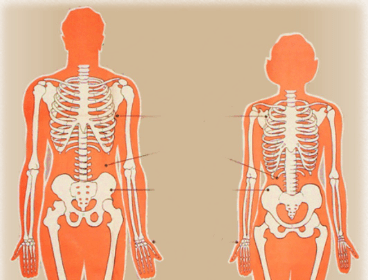
- Skeletons – Women naturally have a wider pelvis than men, which is a key way scientists can identify the gender of a person—by their skeleton long after they’ve died. As stated before, men have larger bones than women, which are also denser. Women have smaller and thinner bones than men, which are slightly more flexible too.
Sexual dimorphism and our hormones also affect us in other important areas, along with our secondary sex characteristics. Men are stronger than women because they have more muscle mass. On average, women are just over half as strong as men in their upper bodies and about two-thirds as strong in their lower bodies. And while both men and women develop muscle at a similar rate, men develop muscle easier because testosterone directly boosts protein synthesis, a process which leads to muscle growth. Along with this, men have greater bone density, as previously mentioned, and a greater lung capacity than women.
All these factors impact the athleticism of men and women. For example in lifting, Lucy Underdown holds the female deadlift record, with 717 pounds and Hafþór Júlíus Björnsson holds the male deadlift record with 1,124 pounds. This can be seen with basketball skills, too. Wilt Chamberlain holds the most points scored in an NBA game with 100 points. The most points scored in a WNBA game by a single player is a shared record between A’ja Willson and Liz Cambage, with 53 points. The most three pointers made by a single player in an NBA game is 14, by Klay Thompson. While in the WNBA it’s 9, a shared record between four different women; Rhyne Howard, Arike Ogunbowale, Jewell Loyd, and Kelsey Mitchell.
In conclusion, men’s and women’s many differences with how they look, their body structures, and their physical abilities are due to a phenomenon called sexual dimorphism, the differences in traits between both sexes of the same species. It’s driven by the difference in which hormone (testosterone or estrogen) our bodies primarily produce and their effects.
 The Talon
Leave a comment